
Aegis board-certified pathologists and pharmacists augment your team to review test results against your patient’s health record. Our MDs and PharmDs send you targeted treatment recommendations, specifically designed for your patient.
Molecular test results are only as useful as the interpretation behind them.
Aegis clinicians add insights and context to every result so you get specific, actionable recommendations you can apply the same day.
Pathology consultation is similar to radiology consultation. When you order an MRI, a radiologist reads it and provides you with an interpretation of results so you make the best clinical decision for your patient. The interpretation comes with the test.
When you request an Aegis consultation with your test order, you expand your clinical team. Our PharmDs review test results along with the patient’s medication and care history, checking for interactions and contraindications. Our board-certified pathologists review the results in context of the individual patient – age, gender, comorbidities, treatment location, and more – to write specific management recommendations for the ordering physician.
The Aegis process works the way radiology does: you order the test and the interpretation comes with it.
Patient record
Medications, diagnoses, interactions, care history all cross-referenced before a single recommendation is written.
Pathologist sign-off
A board-certified Aegis pathologist reviews and approves every report. No result goes back to you without clinical sign-off.
Medical necessity documentation
Audit-ready compliance documentation generated for every case automatically.

Complex patients have the greatest risk. They’re on multiple medications prescribed by multiple physicians, making it difficult to see the full picture.
Aegis reviews the entire drug regimen: checking for interactions between medications that were prescribed independently, flagging dosing issues based on renal function, metabolizer status, and comorbidities. Our team identifies duplicate therapies or outdated labs, and offers prospective recommendations to make the medication regimen more efficient, tolerable, cost-friendly, and efficacious.
For PGx results, that means clear guidance on metabolizer status and drug selection. If your patient metabolizes a statin too slowly, they are accumulating a dose that causes joint pain, brain fog, or worse. if they metabolize an SSRI too fast, no amount of dose escalation will increase efficacy, only side effects.
We identify these challenges before the patient returns wondering why they are not getting better.The organism, genetic variant, or drug-gene interaction identified, written in plain clinical language your care team can act on immediately.
The result is read against your patient’s full chart, including their medications, diagnoses, and history, not as a standalone data point.
A specific recommendation with the clinical rationale behind it, including any contraindications or interactions that would make a standard choice the wrong one.
Every consultation generates audit-ready documentation covering the test order, the clinical rationale, and the recommendation. Protects you and your lab without any extra steps.
Aegis board certified pathologists and PharmDs review results around the clock.
Weekend cases don’t wait until Monday.
Wound, UTI, Respiratory, Women’s Health, STI, GI, and Fungal panel-specific recommendations returned in 2 hours, often faster.
Drug-gene interaction analysis and medication selection guidance, in 1-2 business days, frequently same day.
Missing and outdated labs, drug and dosing adjustments, duplicate therapies, and disease counseling for complex patients.
PharmD-led Guideline-Directed Medical Therapy (GDMT) titrations.
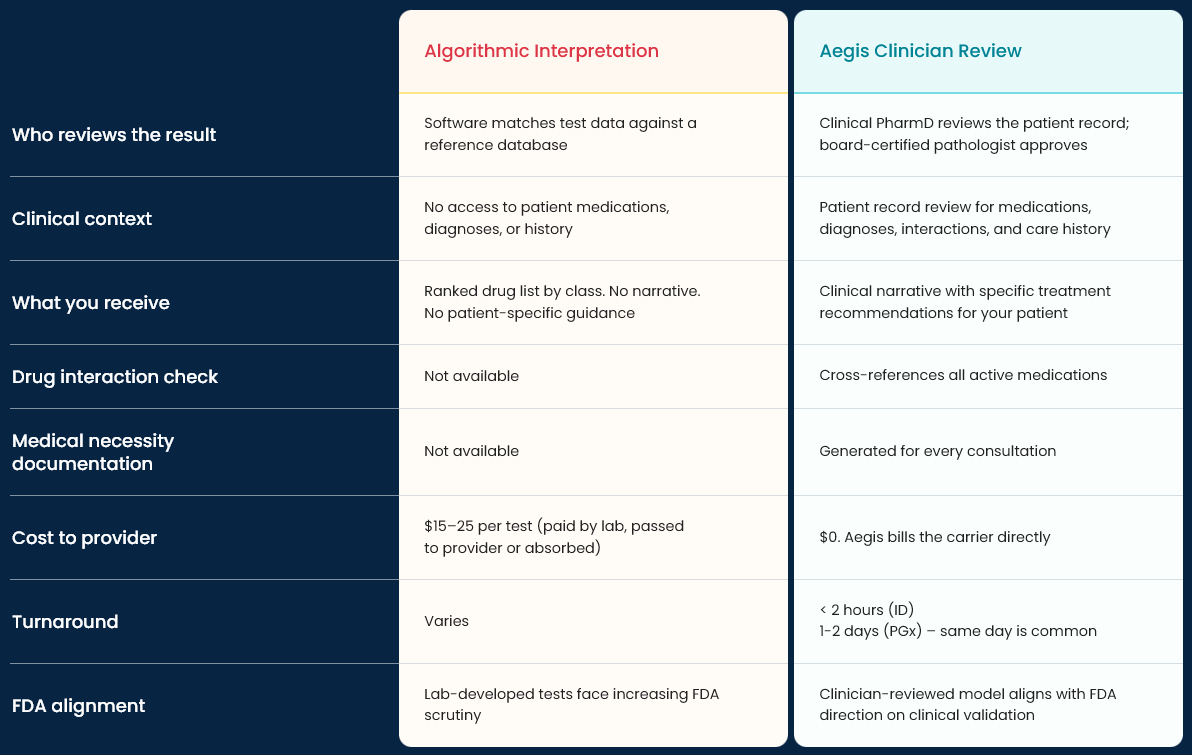
Software matches test data against a reference database
Clinical PharmD reviews the patient record; board-certified pathologist approves
No access to patient medications, diagnoses, or history
Patient record review for medications, diagnoses, interactions, and care history
Ranked drug list by class. No narrative. No patient-specific guidance
Clinical narrative with specific treatment recommendations for your patient
Not available
Cross-references all active medications
Not available
Generated for every consultation
$15–25 per test (paid by lab, passed to provider or absorbed)
$0. Aegis bills the carrier directly
Varies
< 2 hours (ID)
1-2 days (PGx) – same day is common
Lab-developed tests face increasing FDA scrutiny
Clinician-reviewed model aligns with FDA direction on clinical validation
"PCR testing has revolutionized the way I treat infections, but I am still not an expert in genetics-based medicine. I love that an ID expert reviews results and provides treatment advice, which offers me confidence and education."
Diane Helm, FNP, Care First Medical Woodlawn, VA

Aegis bills the patient’s insurance carrier directly using a combination of pathology consultation codes (CPT 80503 through 80506) or Principal Care Management codes (CPT 99424 through 99427), as appropriate. There is no cost to you to start a consult or to receive the results. If the patient has no insurance on file, Aegis contacts them directly.
Every consultation generates data supporting medical necessity that covers both the provider and the lab for carrier audits.
If you have a patient that needs assistance with billing, please have them contact us.
We will walk you through how Aegis fits your workflow, which tests and reviews are available through your lab, and what your patients can expect. Most providers are up and running after a single call.
There is no charge to providers for using Aegis services. Aegis bills the patient’s insurance carrier directly using pathology consultation codes or principal care management codes, specific to the services rendered.
Aegis clinicians review around the clock. Infectious disease PCR with antibiotic streamlining are returned in 2 hours, often faster. PGx and polypharmacy reviews are returned in 1-2 business days, but frequently the same day.
When you order a PGx test and request an Aegis consultation, our clinical pharmacist reviews the test results against your patient’s record: active medications, diagnoses, metabolizer status, and care history. They check for drug-gene interactions, flag contraindications, and write specific medication selection and dosing guidance. Our supervising pathologist reviews and approves the report. You receive a clinical narrative that you can easily digest and utilize to make the best clinical decision for your patient.
You submit a PDF of the patient’s chart with active diagnoses, medications, labs, and relevant clinical notes through your lab’s Aegis portal. You include patient insurance information, a comment requesting the review, and an attestation that the patient has been informed. Your lab will walk you through the process if you haven’t used it before.